
Dundalk Public Records Inventory
Dundalk is an unincorporated Baltimore County community. That fact determines the custodian. County offices in Towson keep local administrative and police material, Maryland court clerks keep deeds and case files, and state agencies run several broad indexes. Baltimore City is a separate jurisdiction. A postal address that says Baltimore does not by itself place an open record there.
| Dundalk record set | Legal keeper | Online access | Copy route |
|---|---|---|---|
| Deeds, mortgages, easements | Baltimore County Circuit Court Clerk | MdLandRec, free account | Images online; plain or certified clerk copies |
| Court cases | Maryland Judiciary and filing-court clerk | Case Search summaries | Full file at clerk; copies by request |
| Parcels, assessments, sales | Maryland SDAT | Real Property Data Search | Free informational record; deed image elsewhere |
| Vital events | Maryland DVR, Circuit Court, or State Archives | Record-specific historical indexes | Eligibility, ID, and record type control copies |
| Police and custody | Baltimore County Police/Corrections or DPSCS | State locator; no county live roster found | Dedicated form, phone, mail, or facility contact |
| Probate | Baltimore County Register of Wills | Maryland Estate Search | Office request; older series at State Archives |
Open does not mean every field is visible. Sealed, shielded, expunged, juvenile, and adoption court matters are excluded from normal public access. Current certificates require proof of eligibility, and motor-vehicle personal data has separate federal limits. A Maryland Public Information Act request cannot override those rules. It can reach existing agency records that lack a purpose-built portal.
Dundalk Deeds Through MdLandRec
The MdLandRec image service is the official route to recorded Baltimore County instruments. It is run by the Maryland Judiciary, the elected clerks, and the Maryland State Archives. Registration is free. Search modes include electronic indexes for individuals, corporations, instruments, and Soundex, plus active and retired indexes. Soundex groups names that sound alike, which helps with variant spelling.
MdLandRec does not provide a Baltimore County address search. Start with the SDAT Real Property Data Search, choose jurisdiction 04, locate the parcel by street address, account identifier, or map and parcel, and copy its deed liber and folio. A liber is the record book; a folio is its page. Return to MdLandRec, select Baltimore County, and use “Jump to New Volume.” The jump opens one page and can display up to ten, while an electronic-index result may retrieve the full instrument PDF.
| MdLandRec field or mode | Input | How it helps |
|---|---|---|
| County | Baltimore County | Keeps Dundalk records apart from Baltimore City |
| Individual / corporation / Soundex | Name | Finds electronically indexed parties and spelling variants |
| Book or volume | Liber from SDAT | Opens a known land book |
| Page | Folio from SDAT | Jumps to the cited deed page |
| Clerk initials | Optional | Refines a volume reference when supplied |
The public landing page does not disclose the exact start of Baltimore County’s electronic name index. Older instruments remain available through scanned books and retired indexes. Clerk copies cost $0.50 per page, with $5 added for certification. Certification is the clerk’s formal statement that a copy is true; it is useful only when the recipient requires legal proof.
Dundalk Property Lookup Limits
SDAT connects a known Dundalk address to owner name, owner mailing address, premises address, account identifier, legal description, map and parcel, assessment, transfer entries, and deed reference. The statewide opening screen does not offer unrestricted owner-name search. It also does not search by town, neighborhood, subdivision, or ZIP. Omit a direction or suffix when an address fails, or truncate the street name with an asterisk.
The Baltimore County My Neighborhood map adds building footprints, zoning, historic districts, census areas, easements, council districts, and county facilities. Use it to settle parcel geography, not as proof of ownership. Mailing address and premises address may differ, and neither proves who occupies a home. A parcel card is an index; the recorded deed is the source document.
Permit and inspection files have a separate fallback. Baltimore County’s permit PIA form accepts facility name, full street address, subdivision, tax map, grid, parcel, lot, tax ID, and case number. Supplying several identifiers reduces errors caused by street variants.
Note: Dundalk ZIP labels do not replace a Baltimore County jurisdiction check.
Dundalk Court Record Access
The Maryland Judiciary Case Search and Record Portal supplies free public summaries for covered District, Circuit, and appellate matters. Baltimore County Circuit civil data starts June 1, 1995, and criminal data starts in June 1984. Statewide District criminal coverage generally begins in late 1991 and civil coverage in 1989, though older-system gaps remain. In March 2026, the Judiciary launched its integrated portal.
A search can be narrowed by party name, role, case type, court, Baltimore County, and filing dates. Partial surnames use at least one first character followed by %; the wildcard cannot begin a term or appear in its middle. Results above 500 are truncated, so a first name, date span, or court filter matters. A docket may show case number, caption, status, filing date, parties, charges, disposition, and event history.
That docket is not the official case file. Pleadings, exhibits, and other papers may exist only with the clerk. Dundalk matters may route to the Circuit Court in Towson or a District Court location such as Essex. Ask for a named document using the case number. Copies are $0.50 per page; certification adds $5 and exemplification adds $10. A portal omission does not prove no courthouse record exists.
Historic Dundalk Land Backstops
Baltimore County land books reach 1661. Their value extends beyond modern parcels: early volumes can include bills of sale, manumissions, and certificates of freedom. The Maryland State Archives holds a Circuit land index for 1851–1921, a grantee index for 1851–1992, a tract index for 1798–1851, and an equity and land-commission index for 1785–1908.
The patent tract index contains 10,767 entries spanning 1658–1965. Those entries may supply a tract name, county, survey or patent date, acreage, and citation. Early descriptions often follow waterways and named tracts rather than current streets, so compare the cited book with later plats and deed recitals. A current Dundalk parcel may represent only part of an older tract.
Dundalk Records Offices and Portals
Most in-person counters serving Dundalk are in Towson. Contact the keeper before traveling, especially when an archived file must be retrieved. The clerk handles deeds, marriage licenses, and Circuit Court files; District Court cases remain with their filing court; vital certificates route to the state office rather than the county health department.
Baltimore County Circuit Court Clerk
401 Bosley Avenue, Towson, MD 21204
410-887-2601
District Court for Baltimore County
8914 Kelso Drive, Essex, MD 21221
410-512-2300
Maryland Division of Vital Records
6764-B Reisterstown Road, Baltimore, MD 21215
410-764-3038
Dundalk Vital Record Rules
Baltimore County Health Department does not issue local certificates. Dundalk applicants use the Maryland Division of Vital Records by appointment, mail, or an approved online vendor. Birth certificates cost $10, death certificates cost $10 for the first copy, marriage certificates cost $12, and divorce verifications cost $12. Online ordering adds a $13 surcharge per certificate. The Circuit Court supplies an actual divorce decree.
Access depends on the event and the requester’s relationship under Health-General Title 4, Subtitle 2 and COMAR 10.03.01. Birth copies may go to the subject, a named parent, guardian, surviving spouse, authorized representative, or a person with legal authority. Death applicants must prove a qualifying relationship, representative role, or legal need. A failed search still produces a Certificate of Record Search, and the fee is not refunded.
Historical routes differ. Systematic Baltimore County birth and death registration began in 1898. The State Archives holds Baltimore County birth records for 1898–1924, while older family research may require church, cemetery, probate, and newspaper material. Archives genealogy PDFs may cost $5 with index detail, while certified paper copies cost $25.
The Maryland birth-record order page shows the certificate channel serving Dundalk.
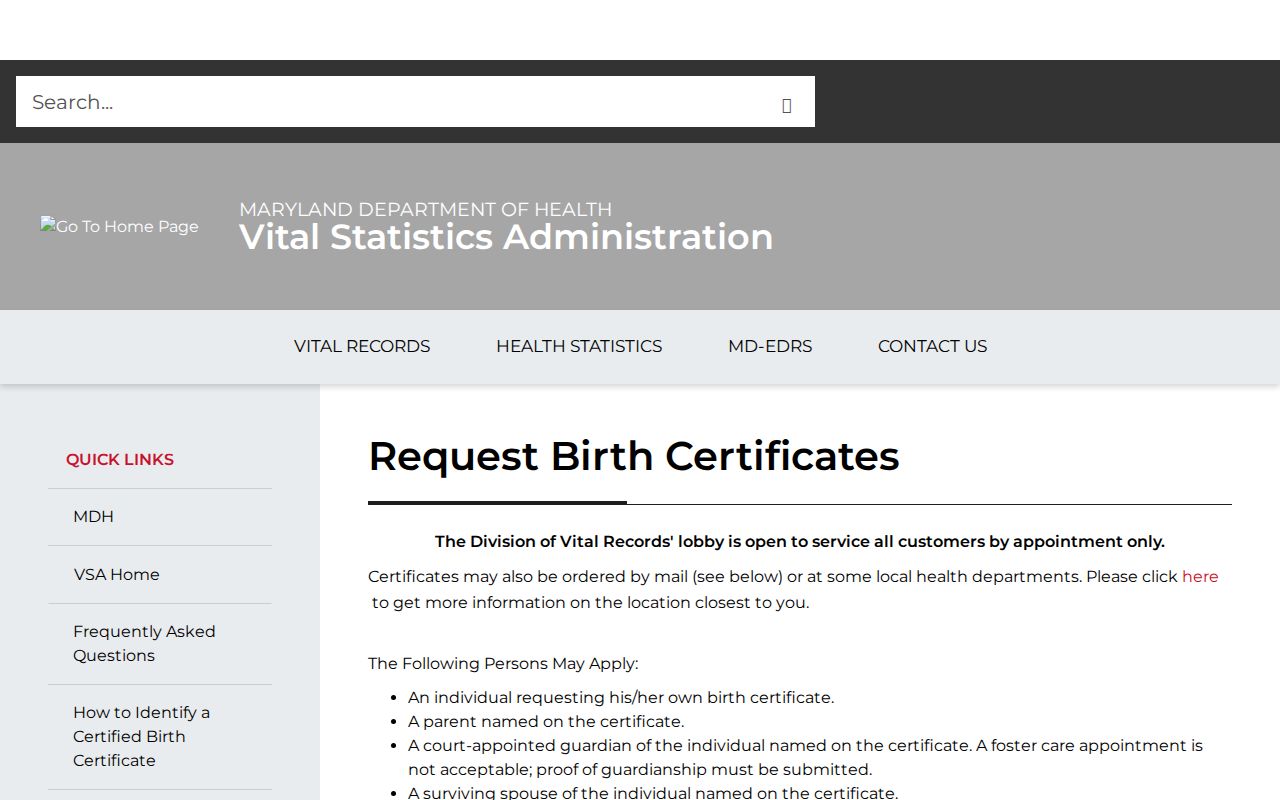
The order screen reinforces a core rule: an online application does not remove identity, relationship, or document requirements.
Dundalk Police and Custody Channels
Baltimore County does not publish a general live jail-roster search in the official sources reviewed. For detention information, contact Corrections at 720 Bosley Avenue, 410-512-3200. Maryland VINE provides custody-location notification, while the DPSCS Incarcerated Individual Locator searches covered state and some detention populations by first and last name. It may omit released people and some short-sentence populations.
Police reports use a dedicated mail form, not a broad portal. Select one incident or motor-vehicle accident report, include payment to Baltimore County and a self-addressed stamped envelope, and mail it to IRMU Records Requests, Baltimore County Police Department, 700 E. Joppa Road, Towson, MD 21286-5501. The fee is $15; a crime victim receives an incident report without that fee. Questions go to 410-887-2390. Redaction may protect an investigation, victim, juvenile, or personal field.
The Maryland Sex Offender Registry is a separate statutory lookup. Its public detail can include name, address, photo, aliases, vehicle, offense, conviction, and registration term. It excludes Social Security numbers and victim data. Never use registry or custody facts to harass, threaten, or impersonate an official.
Dundalk Records Fees Explained
Maryland PIA fees may cover actual search, preparation, and reproduction costs. Under General Provisions §4-206, the first two hours of search and preparation are generally free. A custodian may consider a waiver for public-interest work or indigency. Ask for an estimate before work begins and narrow a broad date range if the cost is high.
- Index
- A locator or summary that points to a source record.
- Certified copy
- A copy carrying the custodian’s formal authentication.
- Custodian
- The office legally responsible for the requested record.
- Exemption
- A law that permits or requires some material to be withheld.
Use the least costly form that fits the need. A free index may settle a date or file number. A plain copy may support family history. Pay for certification only when formal proof is required. Vital, police, court, and archive schedules operate under their own rules, so a PIA fee rule does not replace a purpose-built copy fee.
Protected Dundalk Record Details
Maryland access law separates a public record from protected fields within it. Agencies may redact a public employee’s home address, personal phone, and personal email. Marriage-license applications protect Social Security numbers, and individual financial information is also restricted. Courts withhold sealed, juvenile, adoption, shielded, and expunged matters under court-access rules.
Safe at Home gives qualifying survivors and threatened people a substitute address and mail forwarding. It cannot erase information already public, so protection should be arranged before property or other documents are recorded. Maryland’s Online Data Privacy Act gives rights against covered commercial data processors, but public information is excluded and government agencies are exempt. A commercial deletion request therefore does not remove a deed or court index from its official keeper.
Verify before relying. Compare names, dates, roles, addresses, and source images. A charge is not a conviction, an index can contain a typo, and ownership does not prove occupancy.
Request Dundalk Public Records
The Maryland Public Information Act, General Provisions §§4-101–4-601, lets a person or government unit inspect qualifying existing records. Address the request to the office that created or keeps the material. Name the subject, record type, program, approximate dates, and preferred format. The law does not require an agency to research a person, answer questions, or create a new report.
- Identify the custodian. Dundalk administrative material usually routes to a Baltimore County department, while deeds and court files go to the correct clerk.
- Check the official index or dedicated form. Online records need no PIA request, and vital, police, court, and voter material may use separate procedures.
- Send a focused written request through the Baltimore County PIA channel or the agency’s stated mail, email, or form route.
- Review the day-10 notice when production will take longer. It should explain timing, likely fees, and the reason for delay; a grant or denial ordinarily comes within 30 days.
- Ask for segregable portions if some content is exempt. Challenge a dispute through the Maryland PIA resources, Ombudsman mediation, Compliance Board process, or court where applicable.
A recipient that lacks the record but knows the right custodian should direct the requester within ten working days. Denials should cite legal authority, describe what was withheld without exposing protected content, and identify review rights. A single requester-approved extension may add no more than 30 days in circumstances allowed by the statute.
Lawful personal use. Use Dundalk public records for legitimate research, civic review, family history, estate work, or fraud checks. Never stalk, harass, threaten, or harm anyone.